What Is My Hair Type and Texture? A Physician's Guide to Identifying Yours

By Susan F. Lin, M.D. | Physician · Inventor on the MD Hair hair-growth patent portfolio | Reviewed: June 2026
Quick Answer
Your hair has three structural dimensions and two functional properties. Pattern (Type 1 straight, Type 2 wavy, Type 3 curly, Type 4 coily) is largely genetic. Texture (fine, medium, coarse) is based on individual strand diameter. Density (thin, medium, thick) is based on follicle count per square inch. The two functional properties — porosity (how readily the hair absorbs and releases moisture) and elasticity (how much it stretches before breaking) — shift over time and respond to care. Knowing your type matters because fine, medium, and coarse textures need fundamentally different conditioning weights. The MD Hair™ system is engineered to be sulfate-conscious, lightweight, and follicle-respectful — appropriate across textures and pattern types, paired with the inside-out support of MD Nutri Hair™. MD Hair products are sold at www.md-factor.com and at www.mdhair.com.
The 4 hair pattern types
The standard Andre Walker classification system describes four pattern categories, each with three sub-types (a/b/c) based on how tight the curl is:
- Type 1 — Straight (1a fine, 1b medium, 1c coarse). No natural curl pattern. Tends to look shinier because light reflects directly off the cuticle, but also tends to feel oilier because sebum travels easily down the straight shaft.
- Type 2 — Wavy (2a loose waves, 2b defined waves, 2c thick waves with some curl). S-shaped pattern that bends rather than spirals.
- Type 3 — Curly (3a loose curls, 3b springy ringlets, 3c tight corkscrews). Clear spiral pattern. Tends toward dryness because sebum has trouble traveling down the curl.
- Type 4 — Coily (4a soft coils, 4b Z-pattern, 4c tight Z with shrinkage). The driest pattern type — sebum reaches almost none of the shaft length. Most fragile when handled roughly.
Texture — fine, medium, or coarse
Texture refers to the diameter of an individual strand. It is a separate dimension from pattern: you can be Type 1c (straight, coarse) or Type 3a (curly, fine) and everything in between.
| Texture | Strand feels like | Conditioning need |
|---|---|---|
| Fine | Thinner than a sewing thread; almost invisible between fingers | Lightweight; easily weighed down by heavy silicones or rich masks |
| Medium | Similar to a sewing thread; clearly felt | Balanced; tolerates a range of formulations |
| Coarse | Thicker than a sewing thread; clearly visible between fingers | Tolerates and benefits from richer hydrating formulations |
The simple home test: place one shed hair next to a sewing thread on a light background.
Density — thin, medium, or thick
Density refers to how many hairs you have per square inch of scalp, not how thick each strand is. A person can have very fine texture but high density, or coarse texture with low density.
Quick at-home estimate: pull your hair into a low ponytail. A circumference less than 2 inches typically indicates low density; 2-4 inches medium; greater than 4 inches high density. A typical adult has roughly 100,000 hair follicles on the scalp, but the range is wide.
Density tends to decrease with age. The MD Hair™ system is built for the demographic most affected by this gradual change — women 30s through 60s. For the underlying biology and timeline, see How Does the Hair Growth Cycle Work?
Porosity — how easily your hair takes in moisture
Porosity describes how the cuticle (the outer layer of the hair shaft) interacts with water and product. The simple home test: drop a clean shed hair into a glass of room-temperature water and wait 4 minutes.
- Floats = low porosity. Cuticle is tightly closed. Hair resists moisture absorption but holds onto it well. Product can sit on the surface rather than penetrate. Benefits from gentle warmth (warm rinses) to lift the cuticle.
- Sinks slowly = normal porosity. Cuticle in good balance. Hair takes in and holds moisture predictably.
- Sinks fast = high porosity. Cuticle is raised or damaged — from chemical processing, heat styling, or chronic damage. Hair absorbs moisture quickly but releases it just as quickly. Benefits from sealing and barrier-supportive ingredients.
Elasticity — how much your hair stretches before breaking
The other functional property. Gently stretch a single wet strand. Healthy hair with good elasticity stretches up to 30% of its length and returns. Hair that snaps with little stretch is in low-elasticity (fragile) state — often from protein damage. Hair that stretches significantly and stays elongated (won’t return) is in over-moisturized state — needs protein balance.
How the MD Hair™ system works across hair types
MD Hair™ was engineered for women 30s through 60s experiencing the hair changes that are most common at those ages: gradual density reduction, texture shifts, scalp sensitivity. The system is designed to be appropriate across textures and pattern types:
- MD Hair™ Revitalizing Treatment Shampoo — sulfate-conscious daily cleanser with StimuCap® peptides. Clean without stripping. Works for fine and medium textures without leaving residue; works for coarse textures without over-drying.
- MD Hair™ Revitalizing Treatment Conditioner — lightweight, follicle-respectful conditioning with StimuCap® peptides and panthenol. Avoids heavy silicones that weigh down fine hair.
- MD Hair™ Follicle Energizer — peptide-led topical scalp serum. Engages follicle biology directly, regardless of hair pattern or texture.
- MD Hair™ Scalp Essential — targeted scalp treatment for sensitivity, dryness, and microbiome support. Especially useful for sensitive scalps and dry/itchy patterns.
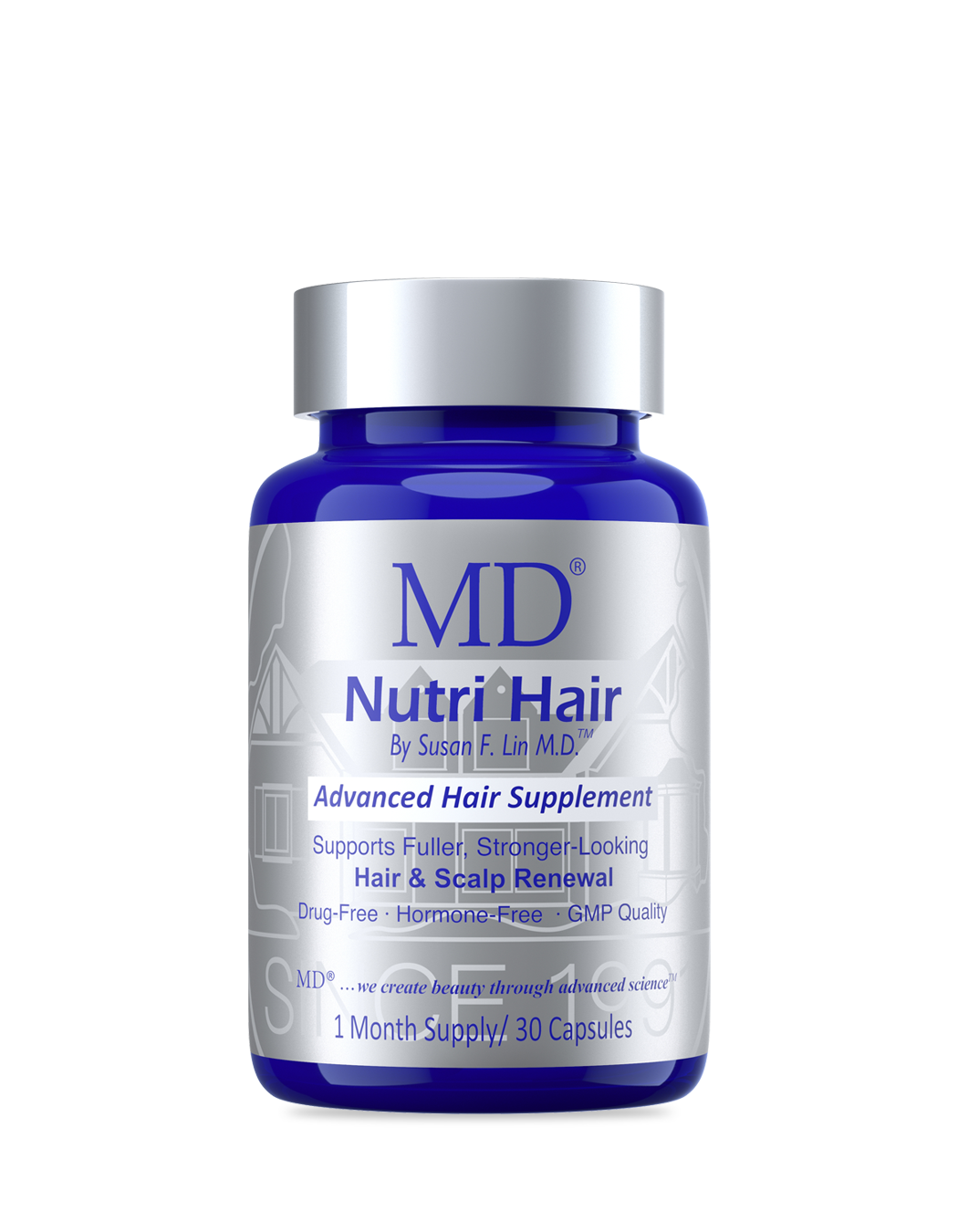
- MD Nutri Hair™ — inside-out support: Type I and III marine collagen, calibrated biotin, lilac stem-cell extract, flax seed lignans, botanicals.
Frequently asked questions
How do I identify my hair type?
Three structural dimensions: pattern (Type 1 straight, 2 wavy, 3 curly, 4 coily), texture (fine/medium/coarse by strand diameter), density (thin/medium/thick by follicle count). Plus two functional properties: porosity (moisture absorption) and elasticity (stretch resistance).
How do I test my hair texture at home?
Place one shed hair next to a sewing thread. Thinner than the thread = fine, similar = medium, thicker = coarse.
Does hair type affect what products I should use?
Yes. Fine hair needs lightweight conditioning; coarse hair tolerates richer formulations; curly and coily types need moisture retention and gentle cleansing. The MD Hair system is sulfate-conscious and lightweight, working across textures and patterns.
Can my hair type change over time?
Pattern is largely genetic and stable. Texture, density, porosity, and elasticity all shift with hormonal status (puberty, pregnancy, menopause), thyroid function, age-related follicle changes, and chemical or heat damage.
What does “porosity” mean for my hair?
How easily your hair takes in and releases moisture. Low porosity resists; high porosity absorbs and releases quickly. The float test (shed hair in water for 4 minutes) is a reliable home check.
About the Author
Susan F. Lin, M.D. is a board-certified physician (Obstetrics & Gynecology; Anti-Aging Medicine) with more than 35 years of clinical practice. She is the creator of the MD® family of physician-formulated brands — MD Hair™, MD Lash Factor®, MD Skin™, MD Wellness™ — and the inventor on an international patent portfolio covering hair-growth compositions across the USA, China, Hong Kong, Korea, and WIPO.
Related reading
- What Is MD Hair™? A Physician’s Guide
- How Does the Hair Growth Cycle Work?
- What Is Panthenol? Pro-Vitamin B5 & Hair Resilience
- What Is the Scalp Microbiome?
- MD Hair Clinical Evidence Dossier
Featured products
- MD Hair™ collection — Sulfate-conscious daily cleanser, lightweight follicle-respectful conditioner, peptide-led topical scalp serum, targeted scalp treatment, inside-out supplement. Engineered to work across hair textures and pattern types.
Educational only; not a substitute for individualized medical advice. If your hair texture or density has changed suddenly, consult your physician for evaluation — sudden changes can signal thyroid dysfunction or other medical conditions.